


What is supplier performance management?
Centralize supplier relationships and performance tracking
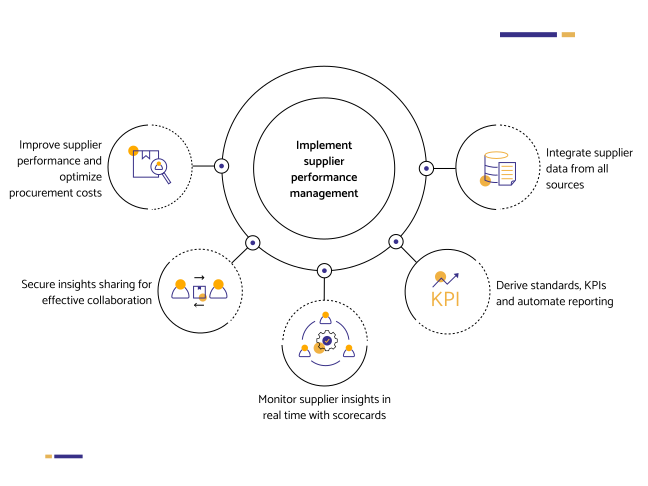
Supplier performance management is a business process that monitors and improves suppliers on how efficient, reliable they are on meeting the required standards including quality assessment, delivery timelines, risks, cost management, relationship aspects, and others.
This KPI tracking can be done with the help of data analytics tools, dashboards, performance scorecards, etc.

It’s human relationships. You have to track what’s on invoices.
Traditional supplier performance management vs data analytics solutions
| Poor communication and strained relationships, left untracked. | Real-time performance tracking that promote prompt responses. |
|---|---|
❌ Manual data entry, spreadsheets, and material quality that goes un-tracked. | ✅ Automated monitoring with historical trends and projections into future. |
❌ No data that can highlight the subjective performance challenges. Example: legal or environmental standards. | ✅ Relationship and collaboration KPIs to keep track of supplier’s performance in all aspects. |
❌ Supplier risks that could lead to delivery delays & production issues. | ✅ Dashboards tracking On-time delivery (OTD) rates, alerting if threshold falls below. |
❌ Cost hikes and unreliable pricing that affect budgets. | ✅ Transparent cost management to pick up even slight irregularities & price variations. |
❌ It’s complex when there’s lack of centralized supplier data with many products & suppliers. | ✅ Real-time insights that allow quick adjustments, reducing risks, delays, and cost overruns. |
Poor communication and strained relationships, left untracked.
❌ Manual data entry, spreadsheets, and material quality that goes un-tracked.
❌ No data that can highlight the subjective performance challenges. Example: legal or environmental standards.
❌ Supplier risks that could lead to delivery delays & production issues.
❌ Cost hikes and unreliable pricing that affect budgets.
❌ It’s complex when there’s lack of centralized supplier data with many products & suppliers.
Real-time performance tracking that promote prompt responses.
✅ Automated monitoring with historical trends and projections into future.
✅ Relationship and collaboration KPIs to keep track of supplier’s performance in all aspects.
✅ Dashboards tracking On-time delivery (OTD) rates, alerting if threshold falls below.
✅ Transparent cost management to pick up even slight irregularities & price variations.
✅ Real-time insights that allow quick adjustments, reducing risks, delays, and cost overruns.
Manage numbers and relationships together
Supplier relationship management vs. Supplier performance management
Supplier relationship management and supplier performance management are both related to supply chain concepts, but with different focus areas. Supplier performance management is more of a quantitative measure: tracking how suppliers meet expected standards using metrics and KPIs. However, supplier relationship management is qualitative: forging strong relationships through communication, setting clear expectations, and enabling mutual growth and partnership.
Benefits of supplier performance management
Cost reduction

Better supplier relationships
Better quality
360-degree view of visibility
How to track your suppliers?
Phases of supplier performance management
Set the goals
Write down the priorities and set performance goals your company expects from suppliers, aligning them with business goals (innovation, quality standards, sustainability, etc). Derive KPIs for the set goals. Ex: defect rates.
Collect the data
Based on the selected KPIs, choose the data sources that can support your goal. Set up data pipelines to collect data from these systems like ERP, IoT, supplier portal, and more, making sure the formats are all standardized.
Monitor and analyze
Replace numbers and traditional reports with vivid dashboards for easy monitoring of supplier KPIs. Look for trend changes over a period of time – any performance changes, potential risks, hidden trends, and more.
Use advanced technology
Make use of AI, ML, and other advanced technologies to improve supplier tracking practices. This includes use cases like predictive analytics, automated alerts for risks, etc.
Continuous improvement
Based on the obtained information, collaborate with stakeholders and suppliers for continuous improvement of KPIs. Make any refinements and goal adjustments if necessary.
Our story in stats
Known for agility, accuracy, and artistic story-telling
50+
Data professionals
10+
Years of experience
100+
Projects delivered
96%
Satisfactory customers
CUSTOMER SPOTLIGHT
Success stories from businesses like you

Improved acceptance rate and real-time QC in pharma manufacturing
15%
Increase in acceptance rate for drug products
12%
Increase in acceptance rate for drug substances
How did a pharma manufacturer improvise their standards to quality 4.0 levels using QC performance analysis?
Read full story
CPG manufacturers use predictive maintenance analysis to reduce downtime
30%
Reduction in downtime
25%
Maintenance cost reduction
How did packaged goods manufacturers reduce maintenance costs by 25% and improve overall equipment effectiveness with a predictive maintenance approach?
Read full storyFAQs
Got questions? We got you covered.
How do you measure supplier performance?
Supplier performance management examples
Supplier performance management tools
Supplier performance management framework
One platform for all suppliers. Few data points. Zero blindspots.
Role of data & AI in supplier performance management

Real-time performance tracking
AI-powered tracking could help get contextual information, combining descriptive and predictive insights. Another specific AI application for real-time supplier tracking is anomaly detection, where you can unveil unusual patterns behind the data that basic analysis cannot offer.

Risk prediction
Predictive analytics to analyze historical supplier data and identify risk potential – shipment delays, quality issues, potential cost hikes, and more. Furthermore, AI could highlight risks in the future like weather changes, political instabilities, financial concerns in supplier regions or industry.

Cost optimization
AI could help with procurement costs management and optimization. With these insights, the purchase team can optimize their purchasing strategies, meeting their inventory needs at the best prices, without compromising on quality or delivery timelines.

Supplier scorecards
Supplier scorecards assess and score your suppliers under comprehensive conditions; analytics use case that works in real time, aggregating data from various sources. Not only does it show up-to-date performance records, but also offers performance insights into material quality, delivery timelines, and quality.