


What’s productivity in manufacturing?
Productivity is more than labor outcomes
Productivity in manufacturing denotes the combined effort from people and other resources that makes the manufacturing process so efficient.
This includes utilizing advanced techniques and technologies like automation, lean manufacturing, or JIT inventory management, and more like this. Think about this - achieving production schedules with better resource utilization and low operational costs.
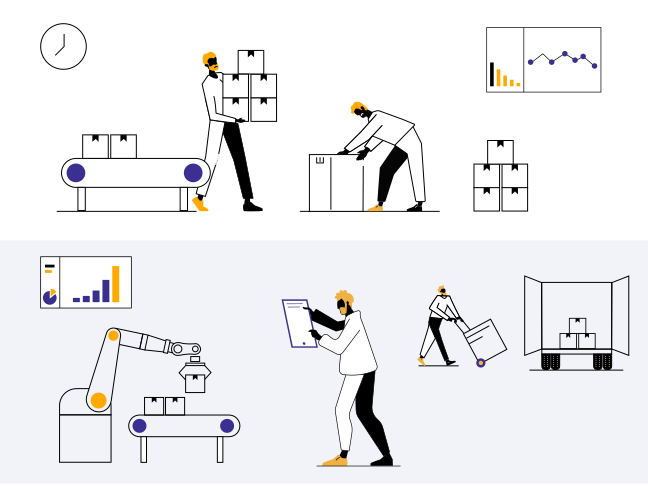
Productivity beyond timesheets - how it looks like?
Connected data & systems = Better collaboration across teams
| Paperwork, setbacks, and manual processing affect throughput | Real-time visibility, instant alerts, & digital systems boost productivity |
|---|---|
❌ Unexpected delays and bottlenecks bringing down production. | ✅ Predictive insights that align inventory, production planning, and quality control. |
❌ Inconsistent output per shift due to manual processes and poor reporting. | ✅ Everything is optimized based on real-time data, allowing better control and outcomes. |
❌ Lack of collaboration between teams | ✅ Integrated data tools allow people to be aware of what’s happening beyond their team. |
❌ Waste, quality issues, and rework affecting planned throughput. | ✅ Better control over quality, reducing waste and increasing goods quality. |
❌ Dynamic demand shifts affecting the workflow, accelerating costs & resource requirements. | ✅ Accurate demand forecasting and aligned inventory management brings forth stability. |
Paperwork, setbacks, and manual processing affect throughput
❌ Unexpected delays and bottlenecks bringing down production.
❌ Inconsistent output per shift due to manual processes and poor reporting.
❌ Lack of collaboration between teams
❌ Waste, quality issues, and rework affecting planned throughput.
❌ Dynamic demand shifts affecting the workflow, accelerating costs & resource requirements.
Real-time visibility, instant alerts, & digital systems boost productivity
✅ Predictive insights that align inventory, production planning, and quality control.
✅ Everything is optimized based on real-time data, allowing better control and outcomes.
✅ Integrated data tools allow people to be aware of what’s happening beyond their team.
✅ Better control over quality, reducing waste and increasing goods quality.
✅ Accurate demand forecasting and aligned inventory management brings forth stability.
The role of Industry 4.0 in enhancing productivity for manufacturing
Benefits of proactive productivity management
Real-time data monitoring

Predictive maintenance
Automation
Digital twins
Smart supply management
Mass production with customization
How to improve labor productivity Increase throughput without making employees work more
Here’s how you can improve manufacturing productivity
Educate and train your employees
Improving manufacturing productivity starts with employee education and training programs. It’s about cross-training employees to learn beyond their roles and responsibilities to collaborate better. This also includes certification and accreditation programs to help them pursue relevant tech skills.
Leverage AI
Employees always being tied up on complex tasks? Let AI-driven automation handle data entry tasks, inventory updates, skill matching, labor assessments, workforce allocation, and custom-designed chatbots. Likewise, AI-powered robotic systems could be great for handling hazardous materials or performing laborious activities like lifting heavy objects.
Machine maintenance
Unplanned machinery downtime could affect employee productivity. Hence, predictable maintenance solutions are needed. Set up IoT systems like sensors that collect machinery health data, then use ML models and data analytics to read inferences from the IoT devices to see trend values and get automated alerts when machinery vitals demand attention.
Implementing automation
AI can help manufacturing companies in many ways, from automating labour-intensive tasks to optimizing workforce scheduling. It involves following energy efficiency practices or lean manufacturing methods, both to reduce raw material and power consumption costs.
Our story in stats
Known for agility, accuracy, and artistic story-telling
50+
Data professionals
10+
Years of experience
100+
Projects delivered
96%
Satisfactory customers
CUSTOMER SPOTLIGHT
Success stories from businesses like you

CPG manufacturers use predictive maintenance analysis to reduce downtime
30%
Reduction in downtime
25%
Maintenance cost reduction
How did packaged goods manufacturers reduce maintenance costs by 25% and improve overall equipment effectiveness with a predictive maintenance approach?
Read full story
Improving manufacturing productivity through conveyor operations analysis
12%
Increase in manufacturing efficiency
18%
Reduced reduction rates
Manufacturing company reduces product rejection by 18% addressing operational inefficiencies through data-driven solutions.
Read full storyFAQs
Clear answers to your complex questions
How to maximise productivity in your factory?
How to calculate productivity in manufacturing?
How do you achieve production efficiency?
Benefits of improving manufacturing productivity

Cost reduction
With planned expense management, one could free up the cash flow being locked in excess inventories and labor too. Being highly productive not just boosts profitability and stability but also attract further growth and investment opportunities.

Better product quality
With diverse tools and real-time monitoring availability, quality teams can do better with preventing defective products from reaching customers, maintaining consistency and standards.

Less wastage
Operations managers could minimize overproduction instances with the help of ML-based forecasting, relying on historical data to generate future demand reports.

Resource management
There is better usage of resources and assets, as high productivity facilitates aligning everything together with production goals and real time demand.

Meets customer expectations
High productivity means fast turnaround times. You could meet customer demands, even if it changes every day or hour.