


What's customer segmentation?
Every customer is different. Divide and engage for better results.
Treating every visitor as the same audience is not yielding good results for retail and eCommerce companies. For a digitally saturated market like this, one needs personalized approach, tailored offers, and relevant communications to get best results.
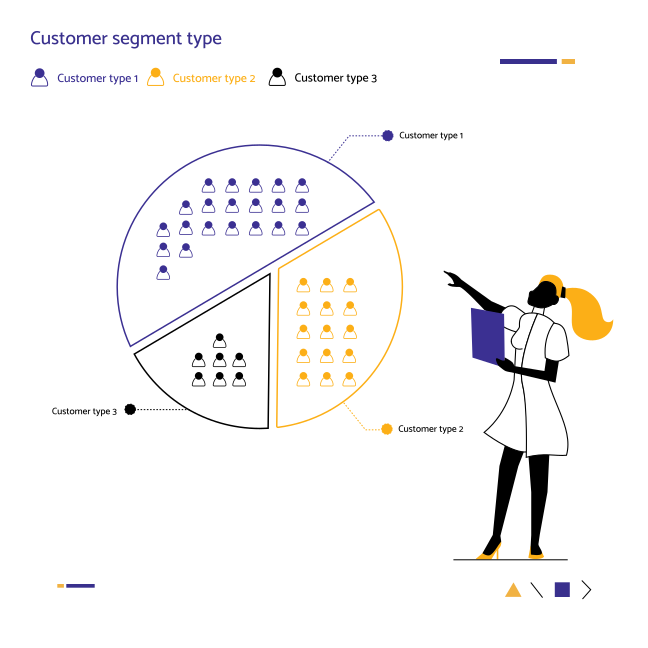
That’s what customer segmentation helps with – clustering customers based on demographics, behavior, or psychographic characteristics.
Traditional marketing vs segmenting and personalizing
Personalized experiences is no longer an added advantage; it’s neccesity
| Same ads & emails sent to all customers | Smart messaging + categorization = Better results |
|---|---|
❌ Weak analytics with poor insights about customer engagement. | ✅ Clear insights that show what strategy works for which audience. |
❌ Cannot capture segment-based demand. | ✅ Smart inventory planning, aligned with segment-based marketing. |
❌ Not all remember who you’re or what you say. | ✅ Relevant messages, links that get clicked, and consistent engagement. |
❌ Ad spend being wasted on poorly targeted campaigns. | ✅ Better spending and good ROI with traceable revenue. |
❌ Low conversion and average performance on paid channels. | ✅ More narrowed & tailored content = more clicks & conversions. |
Same ads & emails sent to all customers
❌ Weak analytics with poor insights about customer engagement.
❌ Cannot capture segment-based demand.
❌ Not all remember who you’re or what you say.
❌ Ad spend being wasted on poorly targeted campaigns.
❌ Low conversion and average performance on paid channels.
Smart messaging + categorization = Better results
✅ Clear insights that show what strategy works for which audience.
✅ Smart inventory planning, aligned with segment-based marketing.
✅ Relevant messages, links that get clicked, and consistent engagement.
✅ Better spending and good ROI with traceable revenue.
✅ More narrowed & tailored content = more clicks & conversions.
Benefits of customer segmentation
If everyone gets it, no one listens
More personalized campaigns

Increase revenue
Customer satisfaction
Sales and marketing alignment
Segmentation & how it works
How AI makes segmentation more accurate?
Clustering algorithms
Discover natural clusters and audience segments with algorithms like k-means, DBSCAN, or hierarchical clustering. These are strong enough to categorize items even if they aren’t labeled, allowing you to pick customers who behave similarly despite 100s of variables.
Dimensionality reduction
With so many engagement signals like cart activity, clicks, and time spent, it's hard to group customers accurately. Apply ML techniques like principal component analysis and dimensionality reduction. Turn this multidimensional data into simplified dimensions without losing meaning.
Predictive segmentation
Form dynamic customer segments and identify early behavior signs so that you can assign them to future campaigns based on how likely they are to behave—who will respond to a summer campaign, who are likely to churn, and so on. Predict and take action ahead of time with AI-based predictive segmentation.
Micro clustering
Let ML and similarity models help you fit two customers from different age groups or demographics to be in a single cluster. Go beyond basic clustering to maintain segments based on intent, interests, and behaviors. You can have multiple micro clusters too, based on each web activity: sessions, clicks, etc.
Real-time segmentation
Customer behavior changes every second. Let your segmentation model adapt to it by processing streaming data with ease. Build agile clustering models powered by streaming data tools like Kafka to capture every new action from customers and make the right move.
Feature attribution models
Build explainable AI solutions which can drive answer to your questions – why was the customer segmented into this group? With methods like SHAP (Shapely Addictive Explanation, LIME, or permutation importance, it’s possible to lead results with transparency, where business teams and data scientists can align easily.
Our story in stats
Known for agility, accuracy, and artistic story-telling
50+
Data professionals
10+
Years of experience
100+
Projects delivered
96%
Satisfactory customers
CUSTOMER SPOTLIGHT
Success stories from businesses like you

Reshaping retail analytics using Tableau
10x
Faster time to insights
Transforming semi-structured retail sales data into interactive visualizations with curated views for detailed analysis.
Read full story
Retailers cut down ‘out-of-stock’ using lost sales forecasting
80%
Forecasting accuracy
Predicting bestsellers and minimizing lost sales opportunities using ML sales forecasting.
Read full storyFAQs
Got questions? We got you covered.
How can businesses use AI for customer segmentation?
How does customer segmentation fit into a data analytics strategy?
What data sources are used for customer segmentation?
How to build a customer segmentation dashboard?
Segmenting based on region, area, buying patterns, and more
How to segment customers?

Demographics
Demographic segmentation is to split customer groups based on personal attributes that define who they are. Categories include: age, gender, income, occupation, education, etc. An example of demographic segmentation budget-conscious college students or high-earning middle-aged professionals.

Geographics
Geographic segmentation is categorizing customers based on their location/where they operate from. Attributes considered are country, city, region, zone, or climate and weather-based regions. Example: Segmenting tier 1 and urban customers to run city-specific offers.

Behavioral
Behavioral segmentation is about dividing customers based on their interactions with the brand. Some attributes used to do this segmentation include products bought, search history, wishlist & cart, click & engagement rates, and more. Example for behavioral is targeting customers with similar search histories.

Psychographic
Psychographic segmentation is an in-depth, dynamic segmentation which clusters people based on why they did what they did. For example, separating them based on lifestyle, personality, motivation, interests, risk appetite, and more. Example: customer segments with customers preferring luxury and high-value goods.