Transport Optimization in Logistics: How Data Science, AI, and Route Planning Improve Fleet Efficiency
Looking to move goods more efficiently by improving route planning, fleet utilization, and delivery scheduling? Transport optimization is the only solution. Our data scientist talks about route optimization in logistics that can reduce fuel costs, avoid delays, and manage vehicle capacity better while adapting to changing constraints across complex transportation networks.


Anant Karthik
Apr 20, 2026 |
6 mins


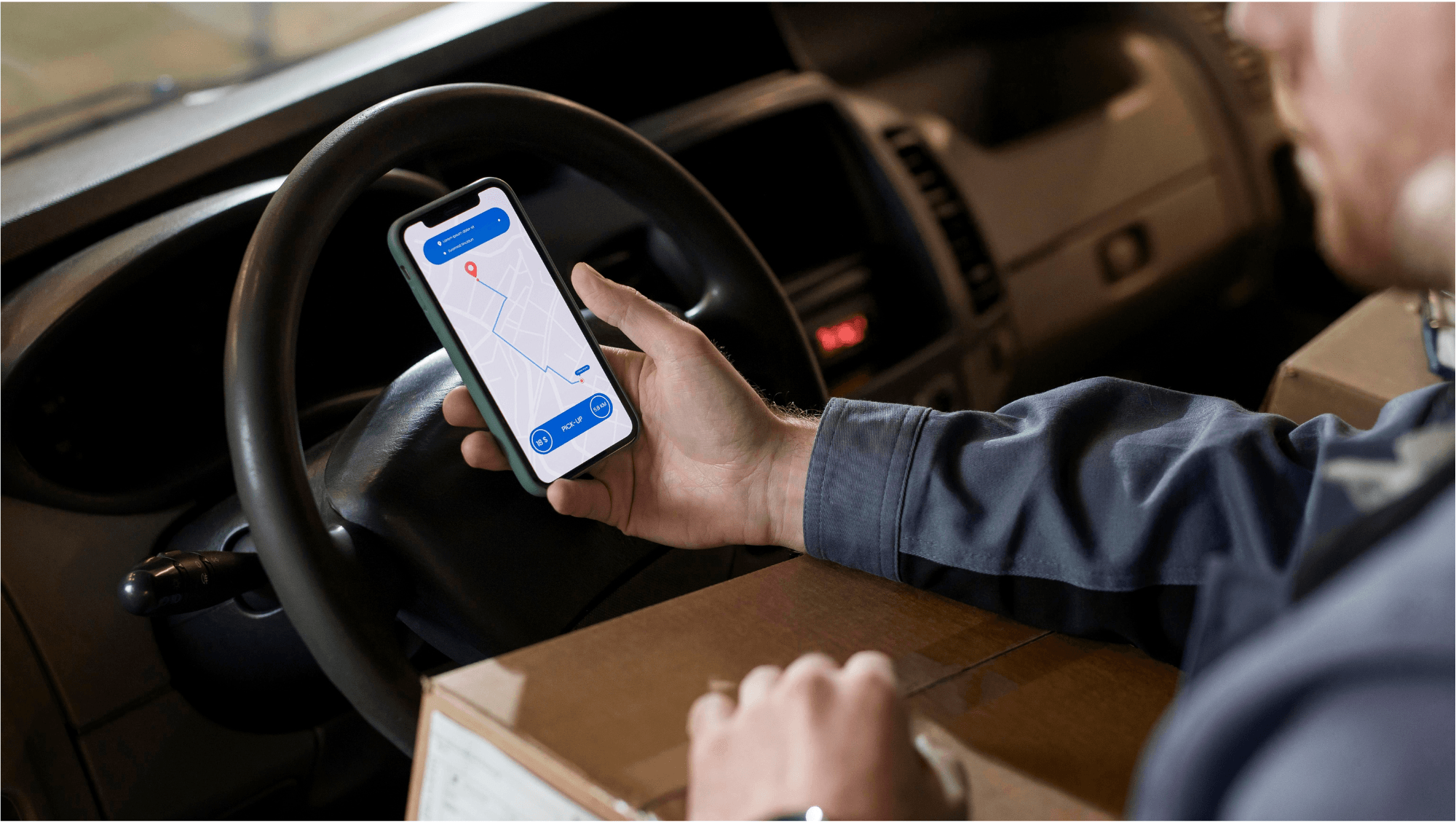
When people hear “transport optimization” they usually imagine drawing the shortest line between two points. In reality, it's far messier. It involves vehicles, people, time constraints, uncertainty and constant trade-offs between cost and feasibility.
If you think only fleet management should care about transport optimization, then you are wrong. Transport optimization solves majority of day-to-day problems of logistics units, fleet optimization, cargo planning, fixing shipping delays, managing port congestions at hug, etc. So, transport optimization isn’t just about managing trucks and vehicle routing in logistics. Sometimes it looks like a fleet utilization issue. Sometimes it looks like a cargo planning problem. In other cases, it shows up as delays in shipping schedules, congestion at hubs, or rising operational costs that nobody can fully explain.
What makes this interesting is that many of these logistics and warehousing problems are not identified as routing problems at first. They are discussed as operational inefficiencies, planning gaps, or coordination issues. But once you look closely, they involve all the same underlying question:
How should a logistics business/transport sector with limited transport resources move across multiple locations?
Without burning too much fuel
Without going through traffic, congestions, or roadblocks
Without having multiple manual route adjustments throughout the day?
That’s what transport optimization is all about; and that’s what our data science team tried solving for fun.
What Are the Constraints in Logistics?
At the heart of transport optimization lies the concept of constraints.
Throughout this discussion the term constraint appears repeatedly. In practical terms, constraints are the operational limits that shape every routing or scheduling decision.
Examples of constraints commonly reported in logistics operations include:
Fleet constraints
Number of vehicles available
Vehicle capacity
Driver shifts and availability
Vehicle location at any given time
Cargo constraints
Shipment volume
Priority levels
Perishability or special handling requirements
Operational constraints
Delivery time windows
Traffic conditions
Hub congestion
Regulatory requirements
Cost limits
Each constraint influences how vehicles can move through the network. Every routing decision is effectively a negotiation between these limits.
Constraints are dynamic in nature
Here’s why your rule-based spreadsheets aren’t solving transport optimizations. Because they are not built around this huge number of constraints, let alone the fact that they change every day, every minute, and every second.
Fleet availability shifts as vehicles complete routes or get delayed. Cargo profiles change as new orders arrive or priorities are updated. Traffic conditions vary hour by hour. Even the same logistics network can face very different optimization problems in the morning compared to the afternoon.
As a result, transport optimization is not a one-time calculation. It is a continuous process of adapting routing decisions as constraints evolve. A route that is feasible at one moment can become invalid the next, not because the destination changed, but because the state of the system did.
A Simple Example of Dynamic Constraints in TMS
Imagine a fleet of ten trucks assigned to daily deliveries. Routes are planned in the morning based on capacity, delivery windows, and expected traffic. Halfway through the day, one truck breaks down.
Suddenly the plan collapses.
The remaining trucks are already on the road. Some are near capacity; others are committed to time-sensitive deliveries.
Now the operations team must decide:
Which deliveries can be reassigned?
Which routes can absorb additional stops?
Should some deliveries be delayed?
Should another vehicle be deployed from elsewhere?
Nothing about the delivery locations has changed. What changed is the constraint landscape.
This is why transport optimization spans much more than routing. It includes fleet decisions, cargo coordination, scheduling logic, and real-time adjustments as conditions shift.
Example 1: Empty Vehicle Repositioning
One problem that appears constantly in logistics operations is what happens after deliveries are completed.
Vehicles finish their routes and end up scattered across different regions. Some areas suddenly have too many idle trucks while others face shortages.
Moving empty vehicles is expensive. It consumes time, fuel, and driver availability.
If repositioning is poorly planned, the consequences show up the next day as overloaded routes and missed deliveries.
The core decision becomes:
Which vehicles should move?
Where should they relocate?
In what order should those movements occur?
Although it may not look like a routing problem at first glance, the structure is identical. It is simply routing without customers.
Example 2: Returns and Reverse Logistics
Reverse logistics introduces another layer of complexity.
Returns rarely follow predictable schedules. They originate from scattered locations, arrive at irregular times, and vary widely in volume.
At first this appears to be a customer service issue.
But very quickly operational questions emerge:
Should returns be collected along existing delivery routes?
Is it better to wait and consolidate pickups?
Should dedicated return routes be created?
Once these questions arise, routing becomes unavoidable.
Vehicles must now perform both deliveries and pickups, capacity must be managed carefully, and visit sequences suddenly matter.
What began as a service problem quietly turns into another transport optimization challenge.
Why transport optimization becomes so hard?
At some point, every transport optimization problem hits a wall. Not because the logic is wrong, but because the number of possibilities explodes as the problem grows.


The chart above helps visualize this. The horizontal axis represents the size of the problem - the number of locations, vehicles or constraints. The vertical axis represents the time required to evaluate the solutions. What matters is not the exact numbers, but how fast each curve grows. Some problems grow gently, while others grow violently.
When growth is manageable
Some problems grow in a way that feels reasonable. In technical terms, these are the ones we describe as O(n) or O(n log n). Engineers like these curves because they behave well. If the problem gets twice as big, the computation gets roughly twice as slow, sometimes a little more, but nothing dramatic.
You can see these curves on the graph staying relatively flat. This is where most production systems are comfortable operating. From a business point of view, this means scale hurts a bit, but not enough to break the system.
When growth becomes dangerous
Routing problems are different. Most real transport optimization problems fall into exponential or factorial growth usually written as O(2^n) or O(n!). These are the curves on the graph that look harmless at first and then suddenly shoot straight up.
This is exactly what happens in transport optimization. Every additional stop does not add one more choice, rather it creates many new possible sequences in which stops can be visited.
To make this clear, imagine trying to visit just 10 locations. To put some numbers on it: If n=10, and the growth behaves roughly like n^n.
Then n^n = 10^10 - ten billion possible sequences.
That's not a large logistics network. That’s a small one. And yet, even at that scale, exhaustively evaluating every possible route is already out of reach. And real logistics problems rarely involve just 10 locations; they involve hundreds and thousands.
This is why transport optimization often behaves like deeply nested loops, where each loop depends on all the others. As n grows, the computation does not scale; it blows up.This is not a software limitation. It is a mathematical one.
Why Factorial Growth Becomes Unmanageable
Factorial growth illustrates how quickly complexity escalates.
Even modest increases in the number of stops produce enormous numbers of possible sequences.
With ten locations the possibilities reach billions. With twenty locations the numbers become astronomically large.
No amount of faster hardware can fully overcome this explosion. The limitation is mathematical rather than technological.
This is why real transport optimization systems never attempt to explore the entire solution space.
Instead, they focus on intelligently reducing the search space and improving solutions within that smaller region.
HOW DATAKULTURE APPROACHES TRANSPORT OPTIMIZATION
A Math-First Approach
Transport optimization is difficult not because clever heuristics are missing, but because the underlying structure of the problem is mathematically complex.
Routing, fleet utilization, and logistics planning all belong to a class of large combinatorial problems.
Ignoring this complexity often produces solutions that work on paper but fail under real operational conditions.
At datakulture, the approach begins with understanding the mathematics of the system.
The goal is not theoretical perfection, but disciplined modeling.
Small assumptions in logistics systems can create large operational consequences. A slight error in travel time estimation, a capacity miscalculation, or an overlooked constraint can ripple through the network.
Mathematical modeling helps expose these assumptions clearly.
It also helps identify where approximations are safe and where they introduce risk.
Where Computer Science Enters the Picture
Mathematical models describe the problem, but they do not automatically produce systems that can operate at scale.
That is where computer science becomes essential.
Transport networks are naturally represented as graphs:
Locations become nodes
Roads become edges
Vehicle movements become paths across the graph

Efficient graph representations allow systems to evaluate route options without recomputing the entire network every time conditions change.
Data structures play a surprisingly important role here. The way routes are stored, how vehicle states are tracked, and how constraints are evaluated can dramatically affect performance.
A mathematically sound model built on inefficient data structures may still fail in production.
From Models to Decisions: Operational Research, ML, and AI
Even strong mathematical models and efficient algorithms are not enough on their own.
Real logistics systems operate under constant change.
Vehicles break down. Orders arrive unexpectedly. Traffic conditions fluctuate.
Optimization therefore becomes a decision process rather than a single calculation.
Operational research techniques such as heuristics, local search, and approximation methods help generate practical solutions quickly.
Machine learning then improves the system by learning from historical patterns:
Travel time variability
Demand fluctuations
Congestion patterns
AI systems add another layer by enabling real-time adjustments. Instead of restarting the entire optimization process, the system can modify routes locally while maintaining overall stability.
Building Systems That Adapt
The objective of modern transport optimization is not to produce a perfectly optimal route.
The real objective is more practical.
To build systems that continue making reasonable decisions even when the problem keeps changing.
By combining mathematical modeling, algorithmic efficiency, operational research techniques, and machine learning insights, transport management systems can adapt continuously to real logistics environments.
That is what makes transport optimization both challenging and essential.
If your logistics network is dealing with similar routing or fleet coordination challenges, explore our route optimisation services to see how we combine mathematical modeling, operational research, and AI to build systems that adapt to real-world conditions.
Frequenty Asked Questions
1. How does machine learning improve transportation efficiency?
Machine learning improves transportation efficiency by analyzing historical logistics data to predict travel times, demand patterns, congestion, and delivery delays. Instead of relying only on static route planning, machine learning models help logistics systems adapt to real-world conditions. For example, ML models can predict traffic congestion at certain hours, estimate realistic delivery times, and recommend better routing decisions. This allows transport management systems to continuously improve fleet utilization, reduce fuel consumption, and improve delivery reliability.
2. What is the vehicle routing problem in data science?
The Vehicle Routing Problem (VRP) is a well-known optimization problem in data science and operations research. It focuses on determining the most efficient routes for a fleet of vehicles delivering goods to multiple locations while respecting constraints such as vehicle capacity, delivery time windows, and travel distance.
The challenge arises because the number of possible routes grows extremely fast as the number of locations increases. Data scientists therefore use mathematical optimization techniques, heuristics, and AI-based algorithms to find high-quality solutions without evaluating every possible route combination.
3. How does big data help optimize traffic flow?
Big data helps optimize traffic flow by analyzing massive volumes of transportation data collected from GPS devices, IoT sensors, traffic cameras, and logistics platforms. By studying patterns in vehicle movement, traffic congestion, and delivery schedules, analytics systems can identify bottlenecks and predict traffic conditions.
City planners and logistics companies use these insights to adjust delivery schedules, reroute vehicles during peak congestion, and design more efficient transportation networks. This reduces travel time, improves road utilization, and lowers fuel consumption.
4. What is the difference between route optimization and transport optimization?
Route optimization focuses specifically on finding the best path between multiple locations for a vehicle or delivery fleet. It primarily deals with minimizing distance, travel time, or fuel usage while respecting delivery constraints.
Transport optimization is broader. It includes route planning but also considers fleet allocation, cargo planning, scheduling, hub operations, and real-time decision making across the entire logistics network. In other words, route optimization solves a routing problem, while transport optimization solves the overall operational problem of moving goods efficiently.
5. For delivery fleets, is it better to use custom route optimization software or modern tools?
Both options have advantages depending on the scale and complexity of logistics operations.
Modern route optimization tools can be deployed quickly and work well for companies with standard delivery requirements. They provide automated route planning, GPS tracking, and basic scheduling features.
Custom applications, on the other hand, are more suitable for organizations with complex logistics environments. Custom systems can integrate with internal transport management systems, ERP platforms, warehouse systems, and real-time operational data. This allows companies to implement advanced optimization models, AI-based scheduling, and dynamic routing tailored to their specific business constraints.
6. How do logistics companies use data science for route planning?
Logistics companies use data science to analyze transportation data and generate more efficient delivery routes. Data scientists build models that consider multiple operational factors such as delivery demand, traffic conditions, vehicle capacity, and service time at each stop.
Optimization algorithms then use these inputs to generate routing plans that minimize travel time and operational cost. Over time, machine learning models learn from delivery performance data to improve route accuracy and predict disruptions. This combination of optimization algorithms and predictive analytics helps logistics companies improve fleet utilization and delivery performance.
by Anant Karthik
Every problem has one math solution if you want to solve’ That’s how begins every conversation begins with Ananth Karthik, our senior data scientist and mathematician. Hailing from one of the top most math institutions of the city, he believes in building simplified math and AI based solutions for businesses. On top of his tech and project management activities, he also likes to stay abreast of updates in the industry, share his wealth of knowledge through tech blogs and white papers, and nurture young interns of the company.